Multi-Layer Cell Culture Flasks for 3D Growth
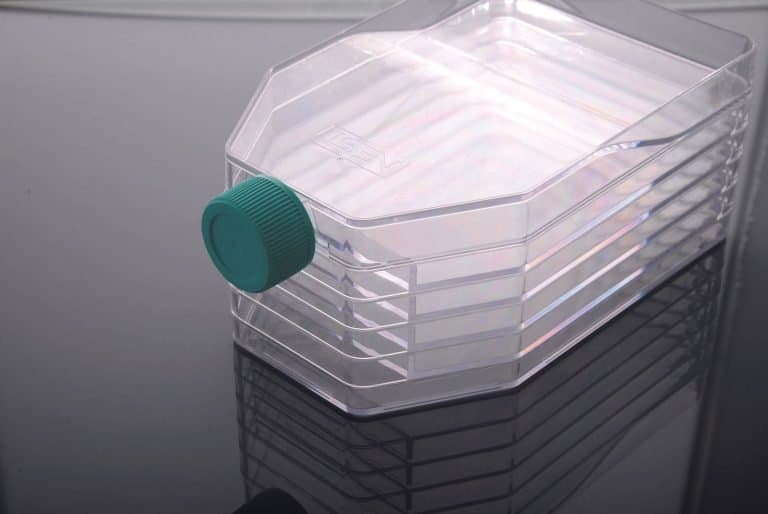
Multi-layer cell culture flasks are polystyrene vessels with stacked growth chambers, available in 3-layer (525 cm²) and 5-layer (875 cm²) formats, used to scale adherent mammalian cell expansion without increasing incubator footprint. Vent cap and plug-seal cap options are available; TC-treated surfaces are standard.
MBP Inc. supplies Nest Scientific multi-layer flasks with same-footprint scale-up to procurement teams at research institutions across the USA and Canada — including registered vendor status with leading institutes such as the Howard Hughes Medical Institute. Contact customerservice@mbpinc.net to request a quote today!
Multi-layer Cell Culture Flasks
Showing 1 to 1 of 1 results
What Are Multi-Layer Cell Culture Flasks?
Multi-layer cell culture flasks are closed, TC-treated polystyrene vessels in which multiple horizontal growth chambers are stacked within a single T-175-equivalent footprint. The 3-layer format delivers 525 cm² of growth surface; the 5-layer format delivers 875 cm² — representing a 3× and 5× increase over a standard T-175 flask, respectively. They are used for adherent mammalian cell expansion workflows, including vaccine production, virus amplification, CHO-cell bioprocessing, and cell-based assay scale-up. Choose multi-layer flasks when you need >T-175 yields without adding incubator shelves.
What you will find:
-
3-Layer Cell Flasks – Increased surface area for mid-scale expansion.
-
5-Layer Cell Flasks – Optimized for high-density, large-scale cell growth.
-
Seal Caps – Provides a secure, liquid-tight closure for static cultures.
-
Vent Caps – Features a 0.22μm membrane for continuous sterile gas exchange.
How to Choose Multi-Layer Cell Culture Flasks
Number of Layers
A 3-layer flask (525 cm²) handles moderate scale-up and is easier to prime with media; a 5-layer flask (875 cm²) maximises yield per incubator position but requires 125–200 mL of media for even distribution. Match the layer count to your target cell number per passage.
Cap Type: Vent vs Plug-Seal
Vent caps incorporate a 0.2 µm hydrophobic PTFE membrane for passive CO₂/O₂ exchange — use when incubating in a 5% CO₂ environment. Plug-seal caps provide a hermetic closure for short-term transport or anaerobic culture.
Surface Treatment
Tissue culture–treated (TC-treated) surfaces are plasma-treated to a hydrophilic, negatively charged state that promotes adherent cell attachment; use untreated variants only for suspension cultures or specific coating experiments.
Material & Sterilisation
Look for flasks made from 100% virgin, USP Class VI medical-grade polystyrene, sterilised by E-beam to SAL 10⁻⁶, and certified DNase/RNase-free and non-pyrogenic. Lot numbers printed on each flask support GMP traceability.
Serological Pipette Access
Flasks accepting 10 mL serological pipettes directly allow liquid aspiration and cell harvest without additional transfer steps — confirm neck design before ordering for high-throughput workflows.
Specifications Context
Both 3-layer and 5-layer formats share common material specs: 100% virgin polystyrene body, HDPE cap, and PTFE vent membrane (vent cap models). Sterilisation to SAL 10⁻⁶ via E-beam irradiation (ISO 11137) is standard. As of 2026, the Nest Scientific 3-layer (cat. 731302) and 5-layer (cat. 731001/731002) remain the most widely distributed mid-tier options. For GMP applications requiring cGMP compliance documentation, Falcon/Corning multi-flasks are the established reference; MBP's Nest Scientific line suits research and process development.
Achieve superior cell growth with validated multi-layer systems. Contact the experts at Molecular Biology Products Inc. for a quote to optimize your laboratory’s output and reliability
FAQ