Cell Scrapers for Mechanical Harvesting of Adherent Cells
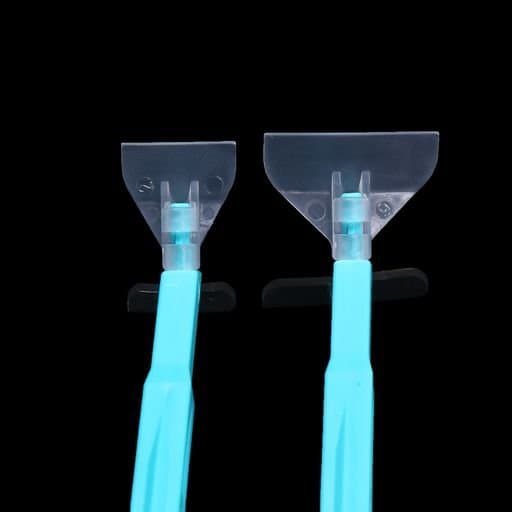
Cell scrapers are sterile, single-use tools with a polystyrene handle and free-rotating polyethylene blade for mechanical harvesting of adherent mammalian cells when enzymatic detachment is not appropriate. NEST Scientific supplies two sizes: 220 mm handle × 13 mm blade (catalog 710001, for T25/T75 and multi-well plates) and 280 mm handle × 20 mm blade (catalog 710011, for T175/T225 and large dishes). Both are E-beam sterilized to SAL 10⁻⁶, DNase/RNase-free, and individually wrapped.
MBP carries NEST Scientific and Biologix Cell Scrapers, with direct PO ordering for labs across the USA, Canada, and worldwide. Contact customerservice@mbpinc.net to request a quote today!
Cell Scrapers

Showing 1 to 2 of 2 results
What are Cell Scrapers?
Cell scrapers are sterile, single-use disposable tools with a polystyrene handle and a free-rotating polyethylene blade used to mechanically detach and harvest adherent mammalian cells from the TC-treated surface of culture flasks, dishes, and multi-well plates when enzymatic detachment (trypsin, Accutase, Dispase) is not appropriate. The free-rotating blade mechanism allows the angle to be adjusted by applying gentle pressure on the handle — the blade twists to align with the vessel surface for consistent, complete cell removal across the full growth area. Choose the 13 mm blade for T25 and T75 flasks and multi-well plates; choose the 20 mm blade for T175, T225, and 100–150 mm dishes, where a wider blade reduces the number of passes needed to clear the full growth surface.
What you will find:
- Cell Scrapers with 18cm Handle for compact culture vessels
- Cell Scrapers with 24.3cm Handle for extended reach in flasks
- 220mm Handle Scrapers with 13mm Blade for precision harvesting
- 280mm Handle Scrapers with 20mm Blade for large-surface area recovery
How to Choose Cell Scrapers
When to Use Cell Scrapers Instead of Trypsin
Cell scraping is the correct harvesting method when:
- Trypsinization damages the protein or surface marker of interest; scraping preserves surface antigens, including CD markers for flow cytometry and receptor proteins for biochemical assays.
- The cell line does not detach effectively with trypsin (some primary cells, fibroblasts in dense monolayers, epithelial cells after extended culture)
- Harvest must be complete and rapid for protein or RNA extraction protocols with RNase-sensitive targets, where trypsin incubation time introduces RNA degradation risk
- The downstream assay uses cells in medium without trypsin carryover (some enzyme assays, reporter gene assays, and cell viability assays where trypsin activity in the sample affects results).
Blade Size by Vessel Format
The 13 mm blade (catalog 710001, 220 mm handle) is designed for T25 and T75 flasks and multi-well plates (6-well through 24-well). The blade width covers approximately 1–1.5 passes across a T75 flask width for complete surface coverage. The 20 mm blade (catalog 710011, 280 mm handle) suits T175 and T225 flasks, 100 mm and 150 mm dishes, and any large-surface vessel where the wider blade reduces scraping passes needed and operator fatigue. Both blade sizes fit through the standard T-flask neck opening.
Free-Rotating Blade Mechanism
NEST Scientific cell scrapers use a free-rotating blade that pivots relative to the handle on a hinge mechanism. Applying gentle lateral pressure on the handle adjusts the blade angle, allowing it to maintain flush contact with the vessel floor during the scraping stroke — improving cell detachment yield compared to fixed-blade scrapers, where the blade angle may not match the vessel floor geometry. After the push stroke, rotating the handle slightly returns the blade to the correct alignment for the next stroke.
Scraping Technique
Add 1–2 mL of culture medium or PBS to the vessel before scraping to lubricate the surface and prevent cells from drying. Work systematically across the flask or dish in parallel overlapping strokes. For T-flasks, tilt the flask at 20–30° to pool the cell suspension at the low end after scraping, then pipette out the suspension. Do not press excessively — scraping force sufficient to detach cells should not require grinding the blade into the vessel floor, which damages cells and the scraper.
Specifications Context
NEST Scientific cell scrapers (catalog 710001 and 710011) are manufactured with a polystyrene handle and polyethylene blade. E-beam sterilized per ANSI/AAMI/ISO 11137 to SAL 10⁻⁶; individually wrapped in easy-tear sterile packaging; non-pyrogenic, DNase/RNase-free per lot certificate. Performance testing is conducted on each manufacturing lot per NEST Scientific standard operating procedures. NEST Scientific cell scrapers are available through MBP in cases of 100 (1/pk × 100/cs). The free-rotating blade design is a confirmed feature per NEST Scientific USA product documentation.
Contact the team at Molecular Biology Products Inc. to request a quote for your laboratory supply needs.
FAQ