Cell Culture Chamber Slides — 2, 4, and 8-Well Systems on Borosilicate Glass
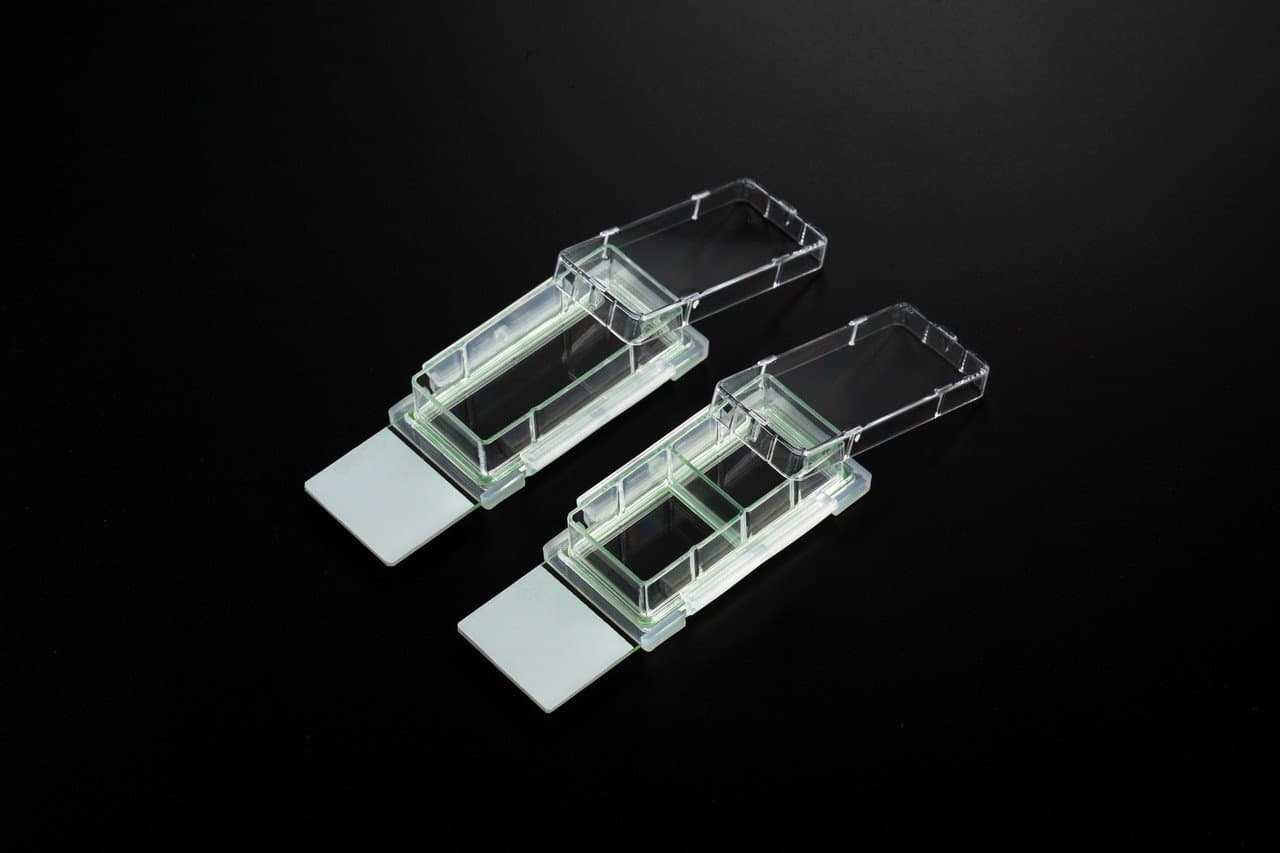
Cell culture chamber slides combine a standard 25 × 75 mm borosilicate glass slide (1.0 ± 0.1 mm) with removable polystyrene chamber walls in 2-, 4-, or 8-well formats, allowing cells to be grown, treated, fixed, stained, and imaged in situ without cell transfer. NEST Scientific chamber slides feature clear, white, or black chamber walls (black for fluorescence cross-talk reduction), an easy-open flip release mechanism, and naturally charged glass growth surfaces. No chemical adhesives in chamber-glass bond; non-cytotoxic, DNase/RNase-free.
MBP carries 2-, 4-, and 8-well formats with direct PO ordering for labs across the USA, Canada, and worldwide. Contact customerservice@mbpinc.net to request a quote today!
Chamber Slides
Showing 1 to 1 of 1 results
What are Cell Culture Chamber Slides?
Cell culture chamber slides are sterile, single-use systems combining a standard microscope slide (25 mm × 75 mm borosilicate glass, 1.0 ± 0.1 mm thickness) with 2, 4, or 8 removable polystyrene or PS chamber walls mounted directly on the glass surface, allowing cells to be grown, treated, fixed, and immunostained in situ on the microscope slide, without any cell transfer step between culture and imaging. After culture and staining, the chamber walls are removed using an easy-open flip release mechanism, leaving cells attached to the glass slide for coverslip mounting and brightfield, widefield fluorescence, or confocal microscopy. Chamber slides are used for immunocytochemistry (ICC), viral studies, toxicity testing, in situ hybridization (FISH), chromosomal studies, and any application requiring high-quality microscopy of cells grown directly on a glass surface.
What you will find:
-
Ultra-thin borosilicate glass and USP Class VI polymers minimize auto-fluorescence for high-resolution microscopy.
-
Precision-molded gaskets provide hermetic, cross-contamination-free separation between experimental wells.
-
Optimize reagent use with versatile 1, 2, 4, and 8-well configurations for high-throughput cell culture.
-
Certified RNase-free, DNase-free, and non-pyrogenic to ensure the reliability of sensitive molecular assays.
How to Choose Chamber Slides
Well Count by Application Scale and Cell Number
2-well chamber slides (growth area 4.55 cm²/well, working volume 1.20–2.50 mL) provide the largest growth area per well — suited for applications requiring large cell numbers per condition (western blot input from chamber-grown cells, cytokine stimulation with media harvest, viral infection with high MOI). 4-well slides (approximately 2.1 cm²/well, 0.5–1.0 mL) are the intermediate format for 2–4 parallel treatment conditions on a single slide. 8-well slides (0.98 cm²/well, 0.20–0.60 mL) allow up to 8 conditions per slide — the standard for immunofluorescence panels with multiple treatment conditions, antibody titrations, and cell line comparison arrays on a single glass slide.
Clear vs. White vs. Black Chamber Walls
Clear polystyrene chamber walls provide visual inspection of the culture through the side wall, allowing phase-contrast observation at low magnification during culture without removing the lid. White chamber walls provide maximum contrast between the well walls and the cell monolayer during visual inspection — useful for monitoring culture progress in labs without a microscope at the culture bench. Black chamber walls (available in 8-well format, NEST catalog 230118) reduce optical cross-talk between adjacent wells during fluorescence imaging with a scanning stage or microplate fluorescence reader.
Glass vs. Plastic Substrate
NEST Scientific chamber slides are built on borosilicate glass slides (1.0 ± 0.1 mm thickness), which are thicker than No. 1.5 coverglass (0.17 mm) — standard for brightfield, phase-contrast, and widefield fluorescence microscopy with long-working-distance 10×, 20×, and 40× dry objectives. For oil-immersion 60× or 100× objectives corrected for No. 1.5 coverglass, mount a No. 1.5 coverslip (0.17 mm) over the cells after staining and use the coverslip as the imaging window. Some chamber slide manufacturers use thinner glass (No. 1.5); confirm the glass thickness against your objective's specification.
Chamber Wall Removal
NEST Scientific chamber slides use an easy-open flip mechanism — a tab or lever on the chamber wall structure that releases the chamber body from the glass slide without mechanical blade or knife use. After cell fixation, staining, and washing in the assembled slide, the chambers are removed by lifting the release tab, leaving cells adhered to the glass substrate. Wash and mount a coverslip directly for widefield or confocal imaging.
Surface Treatment
The NEST Scientific borosilicate glass substrate is described as naturally charged — providing a good growth surface for adherent cells without applied polymer coatings. For primary neurons, primary endothelial cells, or other cells requiring enhanced attachment, pre-coat the glass surface with poly-D-lysine, laminin, fibronectin, or Matrigel before seeding. No surface treatment is applied to the glass by NEST Scientific as the default.
Specifications Context
NEST Scientific cell culture chamber slides are manufactured with borosilicate glass slides (25 × 75 mm, 1.0 ± 0.1 mm thickness) and polystyrene chamber walls. Chamber walls are non-cytotoxic, non-pyrogenic, and DNase/RNase/human DNA-free per lot certificate. No chemical adhesives are used in the chamber-to-glass bond. Chamber walls are released via an easy-open flip mechanism without tools. NEST Scientific is ISO 9001:2015 and ISO 13485 certified with FDA registration. Each pack contains 6 slides; 12 slides per case (2 packs × 6). As of 2026, NEST Scientific chamber slides in 2-, 4-, and 8-well formats with clear, white, and black walls are stocked by MBP.
Achieve consistent, reproducible imaging results with reliable labware. The MBP team can help evaluate your current setup and recommend solutions tailored to your microscopy workflow.
FAQ