Product Filters

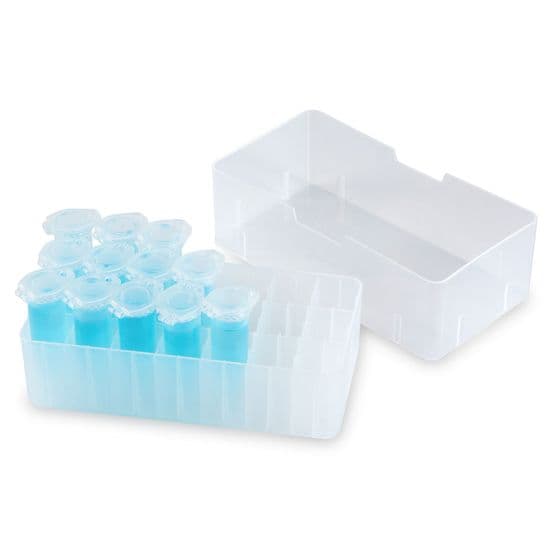
Freezer Boxes for Cryogenic Vial and Sample Storage


Freezer boxes are lidded grid-format containers for organizing cryogenic vials and microcentrifuge tubes inside −80°C ultra-low temperature freezers and liquid nitrogen storage systems. Available in cardboard (water-resistant coated) and polycarbonate hard-wall formats with well configurations of 25, 81, and 100 positions, sized for 1–5 mL cryogenic vials. Both materials are rated from −196°C to +121°C. MBP carries Globe Scientific cardboard storage boxes polycarbonate freezer boxes (ISO 9001:2015 certified) and ships to labs across the US, Canada, and internationally. MBP is a registered vendor for Howard Hughes Medical Institute, Vanderbilt University, and MD Anderson Cancer Center.

Need help selecting the right freezer boxes for your cryogenic storage workflow? — Contact our team at customerservice@mbpinc.net for product recommendations, bulk pricing, and purchasing assistance.

Freezer Boxes
Per Page:
Sort By:

What Are Freezer Boxes?


Freezer boxes are lidded storage containers with a numbered grid of individual wells designed to organize cryogenic vials, microcentrifuge tubes, and centrifuge tubes in ultra-low temperature (ULT) freezers, liquid nitrogen dewars, and vapor-phase cryogenic storage systems. Standard formats include 2-inch (51 mm) and 3-inch (76 mm) box heights, with common well configurations of 25-place (5×5), 81-place (9×9), and 100-place (10×10).

The 81-well, 2-inch freezer box is one of the most commonly used formats for storing 1.8–2.0 mL cryogenic vials in biobanking, pharmaceutical, and research laboratories. Cardboard and hard-wall freezer boxes are both suitable for ultra-low temperature storage, while polycarbonate and polypropylene boxes are preferred for applications requiring repeated handling and autoclaving.


What you will find:


  • Polypropylene Freezer Boxes for 1.5mL and 2.0mL tubes

  • High-capacity Freezer Boxes for 5.0mL midi tubes

  • Universal Freezer Boxes with no wells for bulk storage

  • Alphanumeric Indexed Storage Boxes for rapid tracking

  • Conical-base supported Tube Racks for stability

  • Moisture-resistant Frosted Writing Areas for labeling

  • Autoclavable Cryogenic Boxes for sterile workflows

  • Fully Assembled Storage Systems with secure lids


How to Choose Freezer Boxes


Material: Cardboard vs. Polycarbonate vs. Polypropylene

Cardboard freezer boxes with water-resistant coatings provide an economical solution for long-term storage in −80°C freezers and vapor-phase liquid nitrogen environments. These boxes are lightweight and disposable but are not autoclavable.

Polycarbonate (PC) freezer boxes feature transparent lids that allow sample identification without opening the box and can withstand autoclaving at 121°C. Polypropylene (PP) freezer boxes also support autoclaving and offer enhanced chemical resistance. For frequently accessed sample collections, PC and PP boxes provide greater durability than cardboard alternatives.


Well Count: 81-Well vs. 100-Well

An 81-well (9×9) freezer box is typically designed for cryogenic vials up to approximately 13 mm outer diameter, making it suitable for most 1.8–2.0 mL cryovials.

A 100-well (10×10) freezer box accommodates smaller tubes up to approximately 12 mm outer diameter, including many 1.2–1.5 mL cryovials and standard microcentrifuge tubes, maximizing storage density within the same footprint.


Box Height: 2-Inch vs. 3-Inch

2-inch freezer boxes are commonly used for cryogenic vials up to 2 mL. Larger 3-inch boxes are designed for higher-capacity sample tubes, including 3–5 mL cryovials and selected centrifuge tube formats. When using mixed box heights within freezer racks or drawers, verify rack compatibility before purchasing.


Temperature Rating and Liquid Nitrogen Compatibility

Freezer boxes are available for storage temperatures as low as −196°C. Hard-wall polycarbonate and polypropylene boxes are generally preferred for demanding cryogenic applications and repeated handling. Cardboard freezer boxes are commonly used in vapor-phase liquid nitrogen storage and ultra-low temperature freezers.


Compare Freezer Box Formats


2-inch coated cardboard freezer boxes are available in both 81-well (9×9) and 100-well (10×10) configurations. The 81-well format is designed for 1–2 mL cryovials with outer diameters up to approximately 13 mm, while the 100-well format accommodates smaller 1.2–1.5 mL tubes and cryovials up to approximately 12 mm in diameter. Both cardboard box formats are suitable for vapor-phase liquid nitrogen storage but are not autoclavable.

For laboratories requiring reusable storage solutions, 2-inch polycarbonate are available in 81-well and 100-well configurations. These hard-wall freezer boxes support 1–2 mL cryovials, provide excellent durability for repeated handling, and can be autoclaved at 121°C. Their rigid construction makes them well suited for cryogenic storage applications and routine laboratory use.

For larger sample tubes, 3-inch coated cardboard freezer boxes are available in a 36-well (6×6) configuration. These boxes accommodate tubes up to 5 mL capacity and are commonly used for long-term storage in ultra-low temperature freezers and vapor-phase liquid nitrogen environments. Like other cardboard freezer boxes, they are not autoclavable.


Specifications Context


Freezer boxes are available in multiple materials, dimensions, and well configurations to accommodate a wide range of cryogenic vials and laboratory tubes. When selecting a freezer box, verify tube outer diameter, tube height, and storage requirements to ensure compatibility with the box well dimensions.

For complete cryogenic sample storage solutions, explore cryogenic vials and related cryogenic storage products designed for use in laboratory, biobanking, pharmaceutical, and clinical research environments.

Because "Oops" is not a valid result in your lab notebook. Reach out to the experts at Molecular Biology Products Inc. for a custom quote and stop leaving your samples' future to chance.

FAQ

Freezer boxes are lidded storage containers designed to organize cryogenic vials, microcentrifuge tubes, and centrifuge tubes inside ultra-low temperature freezers (−80°C), liquid nitrogen dewars, and vapor-phase cryogenic refrigerators. Standard freezer boxes are available in 2-inch and 3-inch heights with well configurations of 25-place (5×5), 81-place (9×9), and 100-place (10×10) to accommodate vials from 0.5 mL to 5 mL.
Cardboard freezer boxes are water-resistant coated paperboard with cardboard dividers—economical and disposable, rated from −196°C to +121°C, chemically resistant to alcohols and mild organic solvents. Polycarbonate (PC) or polypropylene (PP) hard-wall boxes offer superior durability, transparent lids for direct visual inventory, reusability after washing or autoclaving, and resistance to cracking under repeated freeze-thaw cycles. Choose cardboard for cost-effective archival storage; choose PC/PP when boxes will be reused frequently or autoclaved.
A standard 2-inch 81-well (9×9) freezer box holds cryogenic vials up to 13 mm in outer diameter and 2 inches (51 mm) in height, accommodating 1.0 mL, 1.5 mL, 1.8 mL, and 2.0 mL cryogenic vials from most manufacturers. The Globe Scientific BioBox 81 is specifically sized for Globe CryoClear 1 mL and 2 mL vials. Confirm outer diameter and vial height before purchasing if mixing vial brands.
A 100-well (10×10) freezer box typically fits vials up to 12 mm in outer diameter in a 2-inch height format. This makes it compatible with 0.5 mL, 1.2 mL, and 1.5 mL cryogenic vials and standard 1.5 mL microcentrifuge tubes. The tighter 10×10 grid provides higher density storage in the same footprint as an 81-well box—useful for large biobanks that prioritize capacity over ease of individual vial access.
Both cardboard and polycarbonate freezer boxes rated from −196°C are suitable for use in vapor-phase liquid nitrogen storage (−150 to −190°C) and standard −80°C ultra-low temperature freezers. Liquid-phase liquid nitrogen immersion requires boxes with a water-tight construction; most cardboard boxes are not rated for direct LN2 submersion. Globe Scientific BioBox polycarbonate boxes are rated for vapor-phase LN2 use and standard freezer storage.
Freezer boxes should be labeled with cryogenic-grade tape and markers rated to −196°C before filling. Write directly on the box lid's printed grid or place a pre-printed cryogenic label on the external box surface. Thermal-transfer cryogenic labels or direct thermal labels rated for ultra-low temperature use offer more legible, permanent identification than hand-written tape. Alphanumeric well grids printed on most box lids allow sample-position logging in a lab information management system (LIMS).
MBP carries Globe Scientific cardboard storage boxes (81-well and 100-well) and BioBox polycarbonate freezer boxes (25-well, 81-well, and 100-well) rated from −196°C to +121°C, designed to fit Globe CryoClear vials. Globe Scientific is ISO 9001:2015 certified. MBP serves research, academic, and clinical labs in the US, Canada, and internationally, and is a registered vendor for Howard Hughes Medical Institute, Vanderbilt University, and MD Anderson Cancer Center.
A typical −80°C upright laboratory freezer (300–500 L capacity) accommodates 16–32 pull-out drawers or racks, each holding 9–12 standard 2-inch freezer boxes side by side. Total capacity ranges from approximately 150 to 400 boxes, depending on freezer model and rack configuration. Polycarbonate racks and divider inserts designed for specific freezer brands (Thermo Scientific, Eppendorf, PHCbi) maximize box density and airflow within the freezer.
We provide the highest quality of products and anytime customer service.
LinkedIn
Featured Categories
online payment
online payment
fast delivery
fast delivery
technical support
technical support
24/7 support
24/7 support
copy right
2026 All Right Reserved